


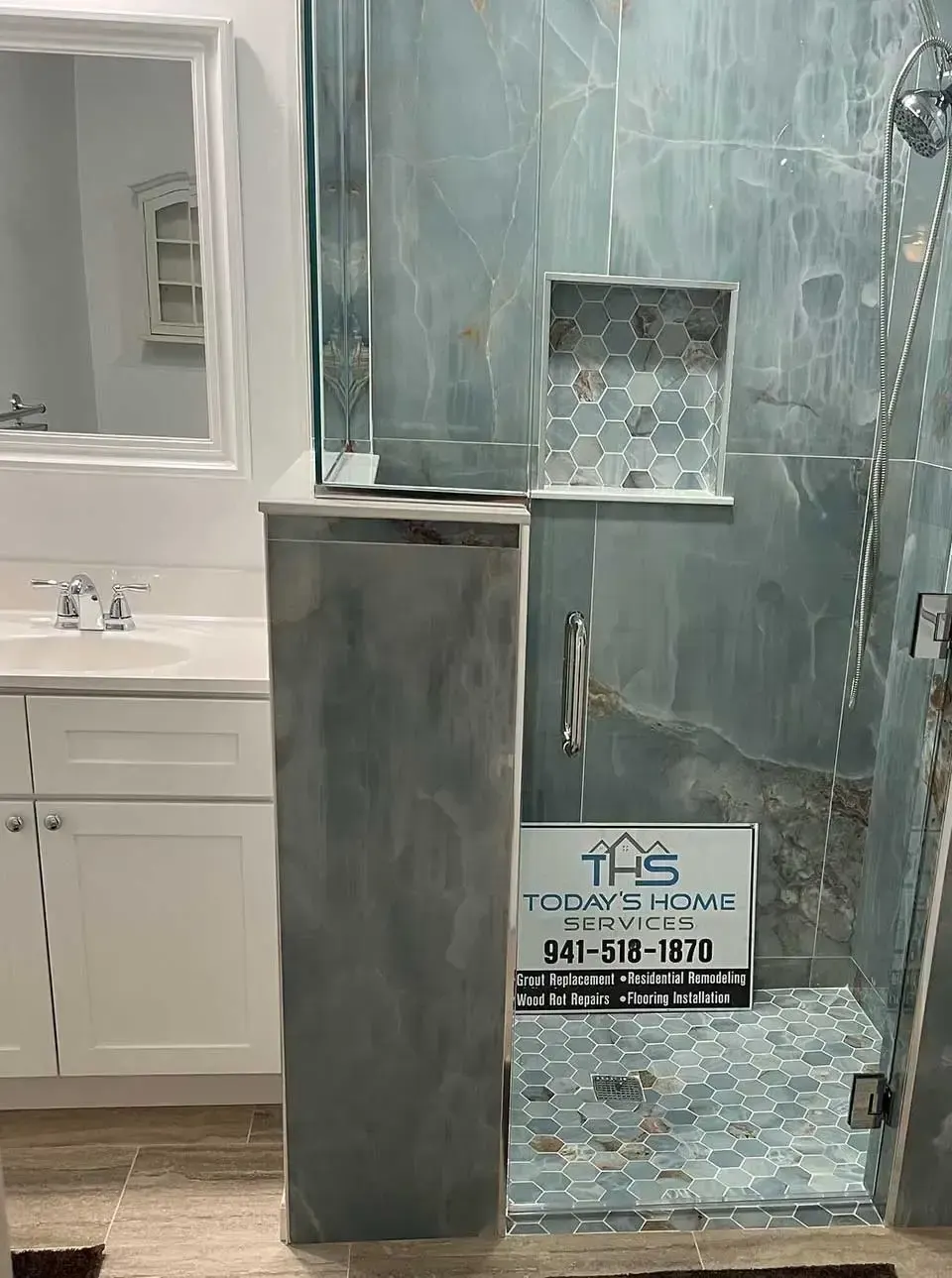
Shower tile rarely fails because the tile itself was bad. It fails because of what's behind and beneath it: the bond, the backer, the pan and the joints that let a shower move.
Key takeaways
- Shower tile almost never fails on its own; the bond, the backer, the pan or the movement joints fail first.
- Hollow-sounding tile on a solid, dry wall can sometimes be repaired locally; hollow tile on a soft wall can't.
- Dark floor grout that never dries usually means the pan underneath is holding water.
- Straight grout cracks in every inside corner point to missing movement joints, which need flexible sealant, not more grout.
Start by letting go of the idea that tile is the important part. Porcelain and ceramic are dense and durable. When a shower starts shedding tiles, sounding hollow or leaking into the next room, the tile is almost always the messenger. The real failure happened in one of four places: the bond between tile and wall, the material the tile is stuck to, the shower pan underneath or the joints that let the assembly expand and contract.
Here's how each of those breaks down, what it looks like from the outside and what it means for the repair.
Failure point 1: the bond (hollow and loose tiles)
Tile is held on by thinset mortar, and the bond is only as good as the contact between mortar and tile. In a shower, industry installation standards call for near-complete mortar coverage under every tile, because any void becomes a pocket where water can collect.
Common reasons the bond comes up short:
- Spot-bonding. Setting tile with dabs of mortar in the corners and center instead of a full troweled bed. It's fast, and it leaves large hollow areas.
- Skinned-over mortar. Thinset spread too far ahead of the tile dries on the surface and never grabs the back of the tile, especially on a hot day in a room without air movement.
- No back-buttering on larger tiles. Bigger tiles and those with ribbed or cupped backs need mortar on the back as well as the wall to get full contact.
- Wrong mortar for the tile. Dense porcelain needs a mortar designed for low-absorption tile. A basic mix may never bond properly.
From the outside, bond failure shows up as tiles that sound hollow when tapped with a knuckle or a coin, tiles that shift slightly under pressure, and grout that cracks around a single tile while the rest stays intact. Once water gets into the gap, it sits there, and each wet-dry cycle weakens the bond further.
Failure point 2: the substrate behind the tile
What tile is stuck to matters more than the tile. Shower walls should be built with a cement-based or foam backer board and a waterproofing layer, not ordinary drywall. Many older showers were built with drywall or "greenboard," which tolerates humidity but is still gypsum with a paper face. When water gets behind the grout, gypsum softens, the paper feeds mold, and the tile loses the solid base it needs.
Substrate problems also come from movement. A wall that flexes, such as one framed with undersized studs or with a large unsupported span, puts stress on rigid tile and grout every time someone leans on it. On the floor, a wood subfloor that deflects under foot traffic cracks grout and tile in predictable lines. Slab floors in Florida are stiffer but can carry cracks of their own that telegraph through tile set directly on them without a crack-isolation layer.
Tip: Press firmly on the wall near a hollow-sounding tile. If it gives, or if the grout around it is dark and stays damp long after a shower, the problem is probably behind the tile, not just under it.
Failure point 3: the shower pan
The floor of a tiled shower is the hardest-working part of the bathroom. It sits in standing water, carries body weight and has to direct every drop to the drain. In a traditional mortar-bed shower, a waterproof liner sits under the mortar and slopes to a clamping drain with small weep holes that let water trapped in the mortar escape.
Pans fail for a few recurring reasons:
- Flat or reverse-sloped liners. If the liner isn't sloped, water sits in the mortar bed instead of draining to the weep holes. The bed stays saturated and smells musty.
- Clogged weep holes. Mortar or debris blocks the weeps, so water has nowhere to go.
- Punctured or poorly folded corners. A nail through the liner near the curb or a badly folded corner is a classic slow leak.
- Curb failures. The curb is where many leaks begin, because the liner has to wrap over it and fastening it improperly breaches the waterproofing.
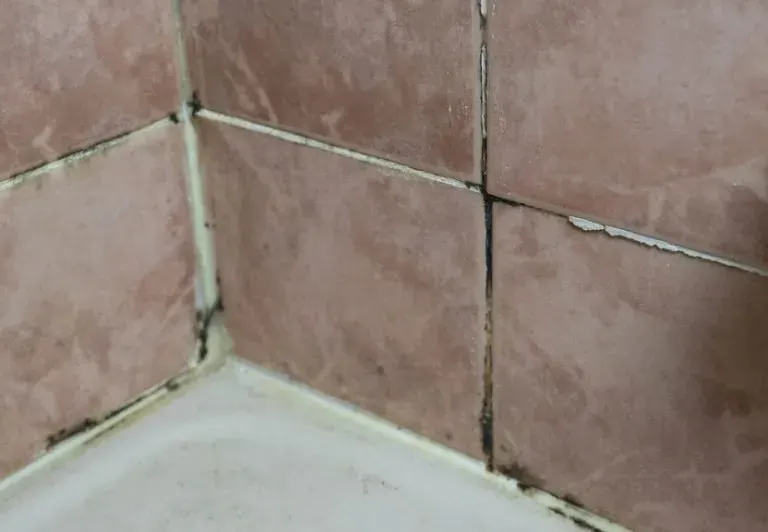
A failed pan shows up as darkened grout that never dries on the shower floor, efflorescence (white crusty deposits) in the grout joints, a musty smell, stained baseboard or damaged flooring just outside the shower, and sometimes tile that sounds hollow near the drain. Re-grouting a failed pan buys very little time. The real fix is replacing the pan with a properly sloped, tested assembly, which our shower pan and waterproofing page describes.
Failure point 4: no room to move
Tile assemblies expand and contract with temperature and moisture. Hot water hits a cold wall, the AC cycles, the sun heats an exterior wall in the afternoon. Industry guidance calls for movement joints at changes of plane (inside corners, where walls meet the floor, where the tub meets the tile) and around the perimeter, filled with a flexible sealant rather than grout.
When an installer grouts every corner solid, the stress has nowhere to go. The result is grout that cracks in a straight line down every inside corner, and in worse cases tile "tenting," where tiles pop up off the floor in a ridge. If the cracking is mostly in your grout lines, our post on what causes grout to crack covers mixing, curing and other grout-specific causes in detail.
Reading the symptoms
| What you see | Most likely cause | What it usually means |
|---|---|---|
| A few tiles sound hollow, wall feels solid | Poor mortar coverage | Localized repair may be possible |
| Hollow tiles plus soft or bulging wall | Wet or failed substrate | Wall needs to be opened |
| Dark floor grout that never dries | Failed pan or blocked weeps | Pan replacement |
| Straight cracks in every inside corner | Missing movement joints | Remove grout, install sealant |
| Cracks running across several tiles | Substrate movement | Investigate framing or slab crack |
| Stains or soft flooring outside the shower | Curb or pan leak | Open and inspect |
Repair or rebuild?
Not every failing shower needs to be torn out. The question is whether the problem is limited to the surface or has reached the layers behind it.
Usually repairable:
- One or two hollow tiles on a wall that's firm and dry when you press on it
- Grout cracks only at inside corners, fixed by removing the grout and installing flexible sealant
- Worn or stained grout on an otherwise sound shower, handled by re-grouting
Usually a rebuild:
- A wall that feels soft, bulges or flexes behind the tile
- A pan that stays wet, with dark grout and efflorescence on the floor
- Tile set over drywall or greenboard that has started to soften
Why the fix is usually bigger than the symptom
The frustrating part of shower tile failure is that the visible area is often small while the damage is not. Water travels along studs, wicks through mortar beds and spreads under adjacent flooring. That's why our answer on water damage behind shower walls covers the warning signs and what happens when the wall is opened.
It's also why a new shower should be judged by what goes into it before any tile shows. The backer, the waterproofing, the pan slope, the mortar coverage and the movement joints decide whether the shower lasts. Our piece on why waterproofing matters more than tile goes deeper on that point, and the shower tile ideas article is the fun part once the structure is right.
If your shower is showing any of the warning signs above, we're happy to take a look and explain what we find. Our shower remodeling team rebuilds failed showers from the studs out, and an estimate is free.
More Why Articles
Frequently Asked Questions
Can I just re-glue a few loose tiles in my shower?
Why do tiles sound hollow when I tap them?
How old is too old for a shower pan?
Is a cracked shower tile always a sign of a bigger problem?
Keep Exploring
-
 Bathroom Service
Shower Remodeling
When a shower leaks, cracks or just looks worn out, a surface fix rarely lasts. We take it back to the framing and rebuild every layer:…
-
 Bathroom Service
Shower Pan Replacement and Waterproofing
Tile and grout are the part of a shower you see, but they aren't what keeps water in. That job belongs to the pan and the…
-
 Why
Why Waterproofing Matters More Than the Tile You Pick
You'll spend hours choosing shower tile and minutes thinking about what goes behind it. That's backwards. Tile is the finish you see; the waterproofing layer is…
-
 Questions
Water Damage Behind Shower Walls: Signs and Next Steps
Loose tile, cracked or darkened grout, peeling paint on the other side of the wall and a musty smell are classic warning signs. Once you suspect…
-
 Blog
What Causes Grout to Crack?
Grout cracks for a reason, and the pattern of the cracks often tells you which one. Here's how to read what you're seeing and decide whether…