


Big tiles look calm and seamless, but they're unforgiving. A dip that a 12-inch tile would ride over becomes an uneven edge you can see and feel on a 24-by-48. Flatness is the price of that look.
Key takeaways
- A long tile bridges dips and humps that a small tile would follow, so floor flaws show up as uneven edges called lippage.
- Standards call for flatter substrates once a tile edge reaches about 15 inches; check the tile manufacturer's instructions too.
- Extra thinset doesn't flatten a floor; grinding, patching and self-leveling underlayment do.
- Leveling clips line up tile edges on a floor that's already flat; they can't fix one that isn't.
Large porcelain tiles are a popular floor finish in Sarasota and Manatee County bathrooms, and for good reason. Fewer grout lines mean less scrubbing and a cleaner, more expansive look. But big tile only looks that way on a flat floor, and skipping the prep is how a big-tile install ends up disappointing. The issue has a name: lippage.
What lippage is and why big tile makes it worse
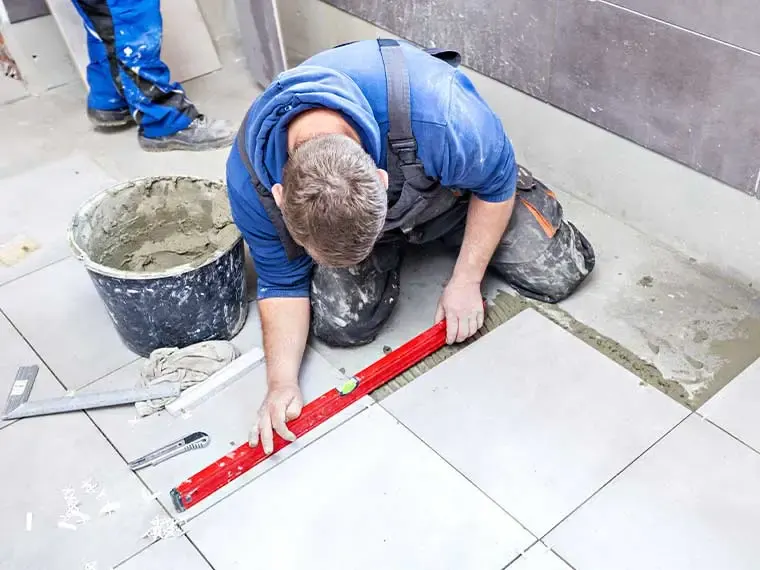
Lippage is the height difference between the edges of two adjacent tiles. A little of it is normal and allowed in industry standards, especially with handmade or natural-cleft materials. Too much, and you see shadowed edges when light comes across the floor, feel ridges under bare feet and catch the vacuum on every joint.
Big tiles amplify lippage for simple geometric reasons:
- They span more of the floor. A 6-inch tile sits in one small area and follows the floor's minor ups and downs. A 48-inch tile bridges a hump or a dip. One end may be high while the other is low, and its neighbor does the opposite.
- Their grout joints are thin. Large rectified tiles are usually set with narrow joints. A wide grout line visually softens a height difference, while a thin one puts the two edges side by side where any mismatch is obvious.
- They're rarely perfectly flat themselves. Long tiles often have a slight bow from firing. On a flat floor, a skilled installer can manage that. On an uneven floor, the bow and the floor dips stack together.
Think of it like laying long boards across a bumpy lawn versus scattering coins on it. The coins don't care. The boards rock.
How flat is flat enough?
Installation standards set tighter flatness requirements as tile gets larger. A commonly cited requirement for tile with any edge 15 inches or longer is that the substrate should vary no more than 1/8 inch in 10 feet and no more than 1/16 inch in 24 inches, measured from the high points. Smaller tile is allowed roughly twice that variation. Your installer should also follow the tile manufacturer's own instructions, which sometimes set stricter limits.
In practice that means checking the floor with a long straightedge or a laser before any tile is bought, not after the mortar is mixed. Many slabs that look perfectly flat fail that test, especially near walls, at old cracks or where a tub or wall was removed.
Why "just use more mortar" doesn't work
A tempting shortcut is to build up low spots with extra thinset under each tile. Standard thinset is designed to be applied in a thin layer, and piling it thick leads to shrinkage as it cures, poor bond and hollow spots. Medium-bed mortars tolerate more thickness, but they're designed to support heavy tiles and absorb minor variation, not to flatten a floor. Fixing flatness is a separate step that happens before tile setting begins.
How a slab gets flat
Most Florida bathrooms sit on concrete slabs, which is good news for tile: concrete is stiff and stable. Getting one flat enough for large-format tile usually involves a combination of these steps.
- Remove the old floor completely. Old tile, thinset ridges, vinyl adhesive and any patching compound that isn't sound all come up. Tiling over old tile adds height and inherits every flaw underneath; our answer on whether you can tile over existing tile explains the trade-offs.
- Grind high spots. A concrete grinder takes down humps, ridges at old wall lines and lumps of hardened mortar.
- Address cracks. Shrinkage cracks are common in slabs. A crack-isolation membrane over them helps keep cracks from telegraphing through new tile.
- Fill low areas. Patching compound handles small dips. For larger areas, a self-leveling underlayment is poured over a primed slab and flows out into a flat plane. It needs to cure per the manufacturer's directions before tiling.
- Re-check. The straightedge goes back down before tile goes in.
On second-story or raised wood floors, the conversation also includes stiffness. A wood floor that flexes under load can crack large tiles and grout even if it's flat, so subfloor thickness, joist spacing and an appropriate underlayment all come into play.
What leveling systems actually do
You've probably seen photos of tile floors covered in little plastic clips and wedges. Those are tile leveling systems. Clips slide under adjacent tile edges and wedges or caps pull them into the same plane while the mortar sets. They're genuinely useful with large-format tile, because heavy tiles can settle unevenly in fresh mortar.
But they only work at the edges, on a floor that's already flat. They can't pull a tile out of a dip or press it down over a hump. If anyone tells you clips make floor prep unnecessary, treat that as a red flag.
Other habits that keep big tile flat
- Full mortar coverage. Large tiles are typically back-buttered and set with a larger notched trowel, with troweling in straight lines to help air escape.
- Sensible offsets. For long rectangular tiles, an offset of around one-third, rather than a half brick pattern, reduces the impact of tile bow.
- Starting from a good layout. Planning cuts so slivers don't land at doorways or against the tub.
- Walls matter too. Shower walls with large tile need straight framing, because a bowed stud shows up as uneven edges.
- Shower floors need a plan. Using large tile on a shower floor usually means a linear drain and a single-plane slope.
The bottom line
The look you want from big tile depends on work you'll never see: the grinding, patching and leveling done before the first tile is set. When it's done right, the result is the calm, nearly seamless floor that made you choose large-format tile in the first place. For design inspiration, see our bathroom floor tile ideas and the tile types overview. When you're ready to move ahead, our bathroom tile, bathroom flooring and tile installation crews check flatness before quoting so the estimate reflects the prep your floor really needs.
More Why Articles
Frequently Asked Questions
What counts as large-format tile?
Can a leveling system fix an uneven floor?
Why do some installers recommend a smaller offset for plank tile?
Do I need a flat floor for wall tile too?
Can you use large-format tile on a shower floor?
Keep Exploring
-
 Bathroom Service
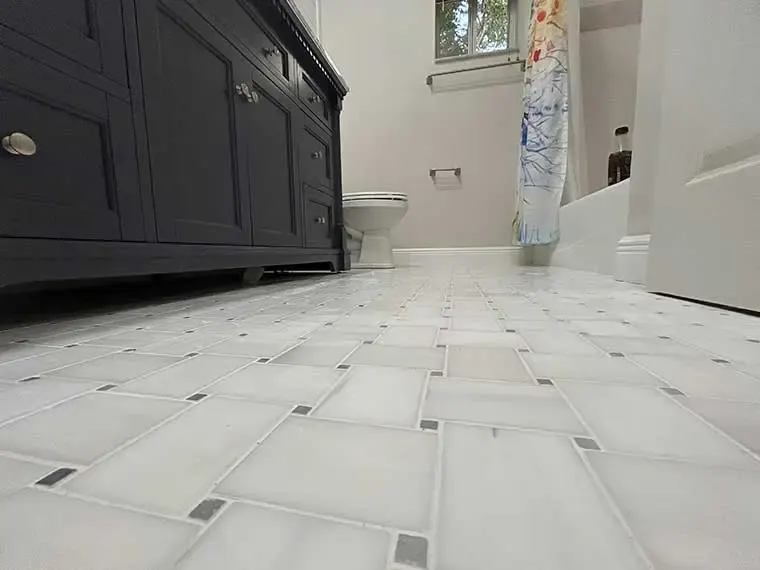
Bathroom Flooring Installation
A bathroom floor takes splashes, steam, dropped bottles and daily traffic. We replace it with tile or waterproof vinyl laid over a flat, sound base, with…
-
Tile Installation
Good tile work is mostly invisible: flat floors, straight lines, tight even grout joints and no hollow spots. We spend the time on layout and surface…
-
 Understanding
Bathroom Tile Types and Where Each One Belongs
Tile is sold by look, but it should be chosen by behavior. How much water a tile absorbs, how hard its surface is and how it…
-
 Ideas
Bathroom Floor Tile Ideas Sorted by What You Need
The right bathroom floor depends less on trends than on who uses the room and how. Start with the problem you want the floor to solve,…
-
 Questions
Can You Tile Over Existing Tile?
Technically yes, in limited situations. On a flat, well-bonded floor or backsplash, an overlay can work. Inside a shower, or anywhere the old tile is loose,…