


You'll spend hours choosing shower tile and minutes thinking about what goes behind it. That's backwards. Tile is the finish you see; the waterproofing layer is what keeps your walls and floor dry.
Key takeaways
- Cement grout is porous and every shower wall has openings, so some water always gets behind the tile.
- A continuous membrane tied into the drain is what keeps that water out of the studs and slab.
- Failed showers tend to leak at the curb, inside corners, niches, valve openings, the drain connection and benches.
- On a tight budget, spend on the waterproofing system and save on the tile, not the other way around.
A tiled shower can let water behind the tile every day it's used and show no sign for a long time. That's why the waterproofing layer, not the tile, decides whether a shower lasts. The tile and grout you see are a durable, easy-to-clean finish. They were never designed to be the thing that keeps water out of your walls. That job belongs to a layer you'll never see once the project is done.
Tile and grout let water through
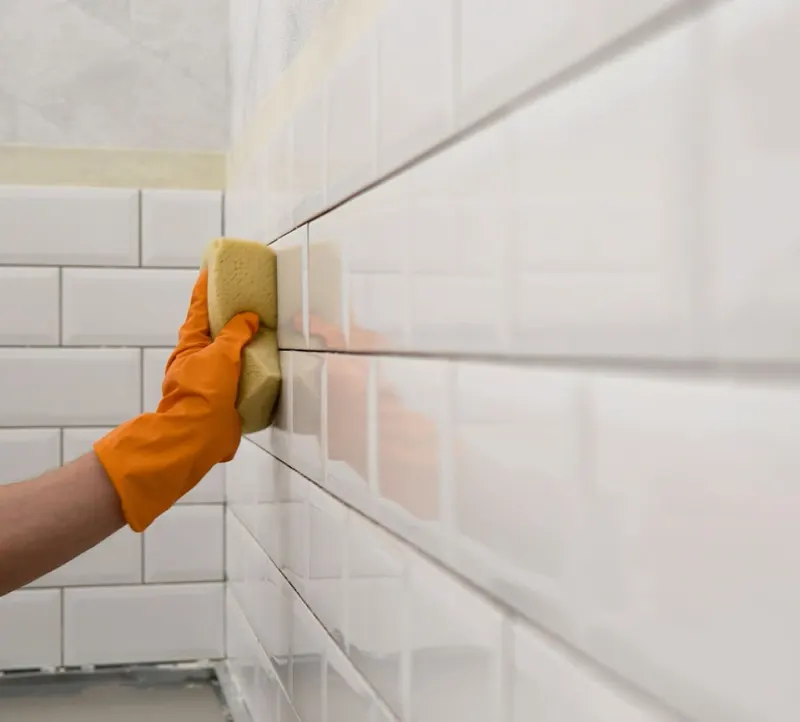
Glazed porcelain and ceramic tile don't absorb much water, but a tiled wall isn't one continuous surface. It's hundreds of pieces separated by grout joints, and standard cement grout is porous. Water soaks into it, through it and into whatever is behind it. Even when the grout is sealed and in perfect condition, some moisture gets through. When grout develops hairline cracks, which it eventually does, more gets through.
Then there are the openings. Every shower wall has holes in it: the valve, the shower arm, a handheld outlet, maybe a body spray or two, a niche, a bench, a window and the joint where the wall meets the floor or tub. Each of those is a path for water if it isn't sealed within the waterproofing layer.
So the right way to think about a tiled shower is this: assume water will get behind the tile, and build so it has nowhere to go but the drain.
What actually keeps water out
A properly built shower has a continuous waterproof layer behind the tile, connected to the drain so any water that gets past the grout is directed back down and out. There are a few common ways to achieve it:
- Surface-applied membranes. Sheet membranes or liquid-applied coatings go on the face of the backer board, directly under the tile. Water stops right behind the thinset.
- Waterproof foam board systems. Lightweight panels that are waterproof themselves, with sealed seams and screw heads.
- Traditional pan liners with a moisture barrier behind the walls. The older approach: a liner under a mortar-bed floor and a vapor retarder behind cement board on the walls. It works when built correctly, but the mortar bed and backer stay wet and rely on weep holes and slope to drain.
Our shower waterproofing systems article explains how each of these works in detail. For this page, the important point is that every method needs to be continuous. A membrane with an unsealed seam, a niche that wasn't wrapped or a valve opening without a gasket is a membrane with a hole in it.
Where showers actually leak
Failed showers tend to leak in the same few places:
- The curb. The top and inside face of the curb take a beating, and fastening glass hardware or a liner through it can breach the waterproofing.
- Inside corners and the wall-to-floor joint. These are changes of plane where membranes have to fold or be reinforced.
- Niches. Recessed shelves create four new inside corners and a flat bottom that can hold water if it isn't sloped slightly outward.
- Valve and outlet penetrations. Pipes that pass through the membrane need a sealed collar or gasket.
- The drain connection. The membrane must tie into the drain properly, or water travels under the pan instead of into the pipe.
- Benches. A flat-topped bench holds water; it should slope toward the shower floor and be fully wrapped.
Notice that none of those problems has anything to do with the tile.
Why this changes how you should spend
If budget is tight, it's tempting to put the money where you can see it, in a premium tile or a fancy fixture, and save on the parts that get covered up. That's the opposite of what lasts. A modest ceramic tile over an excellent waterproofing system will generally outlast an expensive stone over a sloppy one.
| Spend more on | Can save on |
|---|---|
| A complete, manufacturer-matched waterproofing system | Tile cost per square foot |
| Proper pan slope and a quality drain | Decorative accents and borders |
| Sealed penetrations, wrapped niches and benches | Designer fixtures |
| A flood test before tiling | Upgraded trim pieces |
This is also why two estimates for "the same shower" can look so different. One may include a full system with a flood test, and the other may assume tile over cement board with nothing else. When comparing quotes, ask exactly what goes behind the tile.
What to look for in a shower quote
- A named waterproofing system, not just "waterproofing," so you know what's going on the walls and floor.
- A flood test of the pan before any tile is set.
- Pan slope and drain type written out, including how the membrane ties into the drain.
- Sealed penetrations, niches and benches, with niche bottoms and bench tops sloped toward the shower.
A contractor who can explain each of those clearly is telling you how the shower will be built, not just how it will look.
A Florida angle
Gulf Coast bathrooms have extra reasons to take waterproofing seriously. Most homes sit on concrete slabs, so a leaking shower pan can wet the slab and the bottom plate of nearby walls, where it can travel into closets and bedroom carpet before anyone notices. High indoor humidity slows drying, so a wet wall cavity stays wet longer. Mold, which we discuss in why bathrooms get mold in Florida, has an easy time inside a damp wall.
The tile still matters, just second
None of this means tile choice is unimportant. Floor tile needs adequate slip resistance, grout type affects maintenance and staining, and large-format tile needs a flat substrate. Our grout types guide and bathroom tile page cover those decisions. But tile is the second decision, made on top of a shower that's already watertight without it. If you've had a shower fail, our article on why shower tile fails shows how waterproofing failures show up on the surface.
When you're planning a new shower, our shower remodeling and shower pan and waterproofing work starts with what goes behind the tile, and we'll walk you through it as part of a free estimate.
More Why Articles
Frequently Asked Questions
Isn't sealing the grout enough to waterproof a shower?
Is cement board waterproof?
How can I tell if my existing shower was waterproofed?
What is a flood test?
Are acrylic or fiberglass shower surrounds waterproof without a membrane?
Keep Exploring
-
 Bathroom Service
Shower Pan Replacement and Waterproofing
Tile and grout are the part of a shower you see, but they aren't what keeps water in. That job belongs to the pan and the…
-
 Understanding
Shower Waterproofing Systems: How Each One Works
Tile and grout are not waterproof. What keeps water out of your walls and subfloor is the layer underneath, and there are three main ways to…
-
 Why
Why Shower Tile Fails (and What It Tells You)
Shower tile rarely fails because the tile itself was bad. It fails because of what's behind and beneath it: the bond, the backer, the pan and…
-
 Understanding
Grout Types: Choosing the Right Grout for a Bathroom
Grout fills the gaps, locks tile edges together and takes most of the daily abuse in a shower. Choosing the right kind depends on joint width,…
-
 Bathroom Service
Bathroom Wall & Shower Tile Installation
Good tile looks effortless because the hard thinking happened before the first piece went up. We plan every wall, edge and niche so your shower and…