

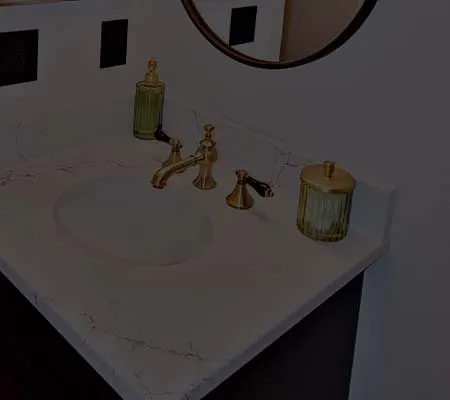
A vanity top lives with toothpaste, makeup, hair products and hard water every single day. The material you choose decides how much of that it shrugs off and how much it remembers.
Key takeaways
- Quartz and solid surface are non-porous and need no sealing; granite and marble usually do.
- Marble is calcium-based, so acidic cleaners and cosmetics can etch it.
- Stock tops fit common cabinet sizes quickly; templated custom tops fit any size and suit stone remnants for small vanities.
- Whatever the material, wiping the faucet base dry is what keeps hard-water scale from building up.
Kitchen countertops get most of the attention, but a bathroom vanity top has its own job description. It sits in a humid room, sees standing water around the faucet base and collects products that stain: hair dye, nail polish remover, self-tanner, toothpaste. In much of the Gulf Coast, it also deals with hard water leaving a white ring wherever drips dry.
This guide puts the common vanity top materials side by side, then explains how each one behaves in daily use.
The quick comparison
| Material | What it is | Stain resistance | Heat/scratch | Sealing | Seams/sink options |
|---|---|---|---|---|---|
| Quartz | Engineered stone: crushed quartz + resin | High | Good scratch; avoid direct high heat | Not typically needed | Undermount, vessel, integrated on some |
| Granite | Natural igneous stone | Good to high (varies) | Very good | Periodic, usually | Undermount, vessel |
| Marble | Natural metamorphic stone | Lower; etches from acids | Softer, scratches | Yes, regularly | Undermount, vessel |
| Cultured marble | Cast resin and stone dust with gel coat | Good | Can scratch or dull | No | Usually integrated bowl |
| Solid surface | Acrylic or polyester resin with fillers | Good | Scratches but repairable | No | Integrated bowl possible, seamless joints |
| Porcelain slab | Large, thin sintered porcelain panel | High | Very good; edges can chip | No | Undermount, vessel |
| Tile | Ceramic or porcelain tile over a backer | Tile high; grout lower | Good | Grout, usually | Drop-in or undermount; grout lines to clean |
| Laminate | Plastic laminate over particleboard or MDF | Fair | Can scorch or chip | No | Drop-in sink; seams vulnerable to water |
Material by material
Quartz
Quartz is a popular remodel choice, and it's easy to see why. It's non-porous, available in clean whites and convincing marble looks, and it resists most staining from cosmetics. Edges and cutouts are fabricated to order. The main cautions are heat from styling tools left lying directly on the surface and strong solvents, which some manufacturers advise against. Our quartz and granite countertop service supplies and installs both.
Good fit for: busy family bathrooms, primary suites, anyone who wants the stone look with little upkeep.
Granite
Every slab is unique, with speckles, movement and color variation that engineered products imitate but do not duplicate. Granite is hard and tolerates hot tools well. Porosity varies by stone, so sealing frequency varies too. Polished dark granites look dramatic but show water spots and soap film quickly in hard-water areas.
Good fit for: homeowners who want natural stone with strong durability.
Marble
Marble is timeless and, in a bathroom, beautiful. It is also the most demanding material on this list. It's calcium-based, which means acids etch it (the same issue covered for marble tile in bathroom tile types): some cleaners, lemon juice, certain toners and even some soaps can leave dull marks. It also scratches more easily and needs sealing. Many people accept the patina; others prefer marble-look quartz.
Good fit for: a powder room or a primary bath where you are comfortable with gentle cleaners and visible aging.
Cultured marble
Common in older Florida homes, cultured marble is cast in molds, often with the bowl formed right into the top, so there is no sink seam to collect grime. Modern versions come in more patterns than the swirled beige many people remember. The gel coat finish can dull or scratch, and cracks around the drain can appear with age or impact.
Good fit for: hall baths and budget-conscious projects where an integrated bowl is a plus.
Solid surface
Made from acrylic or polyester resins, solid surface tops are uniform through their thickness, which means light scratches can often be sanded out. Seams can be joined nearly invisibly, and integrated sinks are common. The look is more matte and uniform than stone.
Good fit for: clean, modern designs and accessible bathrooms where an integrated, easy-wipe surface matters.
Porcelain slab
Large-format porcelain panels can be cut into vanity tops. They're dense, stain-resistant and need no sealing, with very convincing stone looks. Thin edges can chip if struck, so edge detailing matters.
Good fit for: modern bathrooms, or matching a porcelain shower wall.
Tile
Tile tops were common decades ago and still turn up in older homes. They're inexpensive and heat-proof, but grout lines on a flat counter collect grime and need sealing.
Good fit for: budget refreshes or a deliberate vintage look, ideally with a stain-resistant grout.
Laminate
Thin plastic laminate bonded to a wood-based core. It comes in many patterns and is the most economical option. Its weakness in a bathroom is water: if moisture gets past the edge or the sink cutout into the core, it swells and does not recover.
Good fit for: short-term updates, rentals or utility spaces.
Things that matter as much as the material
Sink type
Undermount sinks look clean and make wiping crumbs into the bowl easy, but they require a solid material like stone, quartz or solid surface. Integrated bowls remove the seam entirely. Vessel sinks sit on top and change faucet height. Our page on bathroom sinks and faucets covers the pairing.
Edge profile
Eased or slightly rounded edges are gentler on hips in a narrow room and less prone to chipping than sharp square edges.
Thickness and overhang
Stone and quartz tops are commonly fabricated in standard slab thicknesses, and thicker material can look more substantial on a large double vanity. A small overhang past the cabinet face helps drips fall to the floor rather than run down the doors. In a narrow bathroom, keep that overhang modest so the edge does not catch on hips or clothing.
Stock tops vs. custom-fabricated tops
Stock tops come in standard widths and depths matched to common vanity cabinets, often with a sink already cut or integrated. They're quick to get and simple to install.
Custom tops are templated after the cabinet is set, then cut to fit the exact walls, sink and faucet. Lead time is typically longer, depending on the material and the fabricator's schedule. For a small vanity, a stone remnant can make a custom top affordable, which is why it's a favorite trick in powder rooms.
Backsplash and side splash
A short splash of the same material protects the wall where water collects behind the faucet. Some designs run wall tile down to the top instead.
Tip: Whatever material you choose, the faucet base is where hard-water scale builds first. Wiping that area dry after use is the single habit that keeps a top looking new. For more on scale, read why hard water damages bathroom fixtures.
Choosing with confidence
Start with how the bathroom is used. A kids' bath needs forgiving and stain-resistant. A primary suite may justify a natural stone you love. A guest bath can splurge on looks because it sees light use. Browse bathroom vanity ideas for style direction, then visit our bathroom vanity installation page to see how tops, cabinets and plumbing come together. At a free in-home estimate we can bring samples so you compare materials in your own light.
More Understanding Articles
Frequently Asked Questions
Is quartz or granite better for a bathroom vanity?
What is cultured marble, and is it real marble?
Can I put a new top on my existing vanity cabinet?
Which vanity top is easiest to keep clean with hard water?
Keep Exploring
-
 Bathroom Service
Bathroom Vanity Replacement & Installation
The vanity is the piece you use most and notice first. We replace worn, swollen or undersized vanities with cabinets and tops that fit the room,…
-
Quartz and Granite Countertops
Your countertop is the hardest-working surface in the house. We help you weigh granite and quartz against how you cook and clean, coordinate the slab and…
-
 Ideas
Bathroom Vanity Ideas, One Decision at a Time
A vanity is really five choices stacked together: the cabinet, the sink setup, the top, the faucet and the mirror. Work through them in order and…
-
 Bathroom Service
Bathroom Sinks and Faucets
The sink and faucet are what you touch every morning and every night. Getting the basin, the faucet drilling and the finish to work together is…
-
 Why
Why Hard Water Damages Bathroom Fixtures
The white crust on your shower head and the haze on your glass door are the same thing: minerals left behind when water evaporates. Over time…