


A whole house water filter treats water once, where it enters your home, so every faucet, shower and appliance gets the benefit. Here's how these point-of-entry systems are set up and what to weigh before buying one.
Key takeaways
- A whole house water filter sits on the main line, so every faucet, shower and appliance gets treated water.
- Stages run in order, with sediment first, then carbon, then a softener or specialty stages only if your water test calls for them.
- A carbon filter won't stop scale; hardness takes a softener.
- Size the system for peak flow so showers don't weaken when the dishwasher runs.
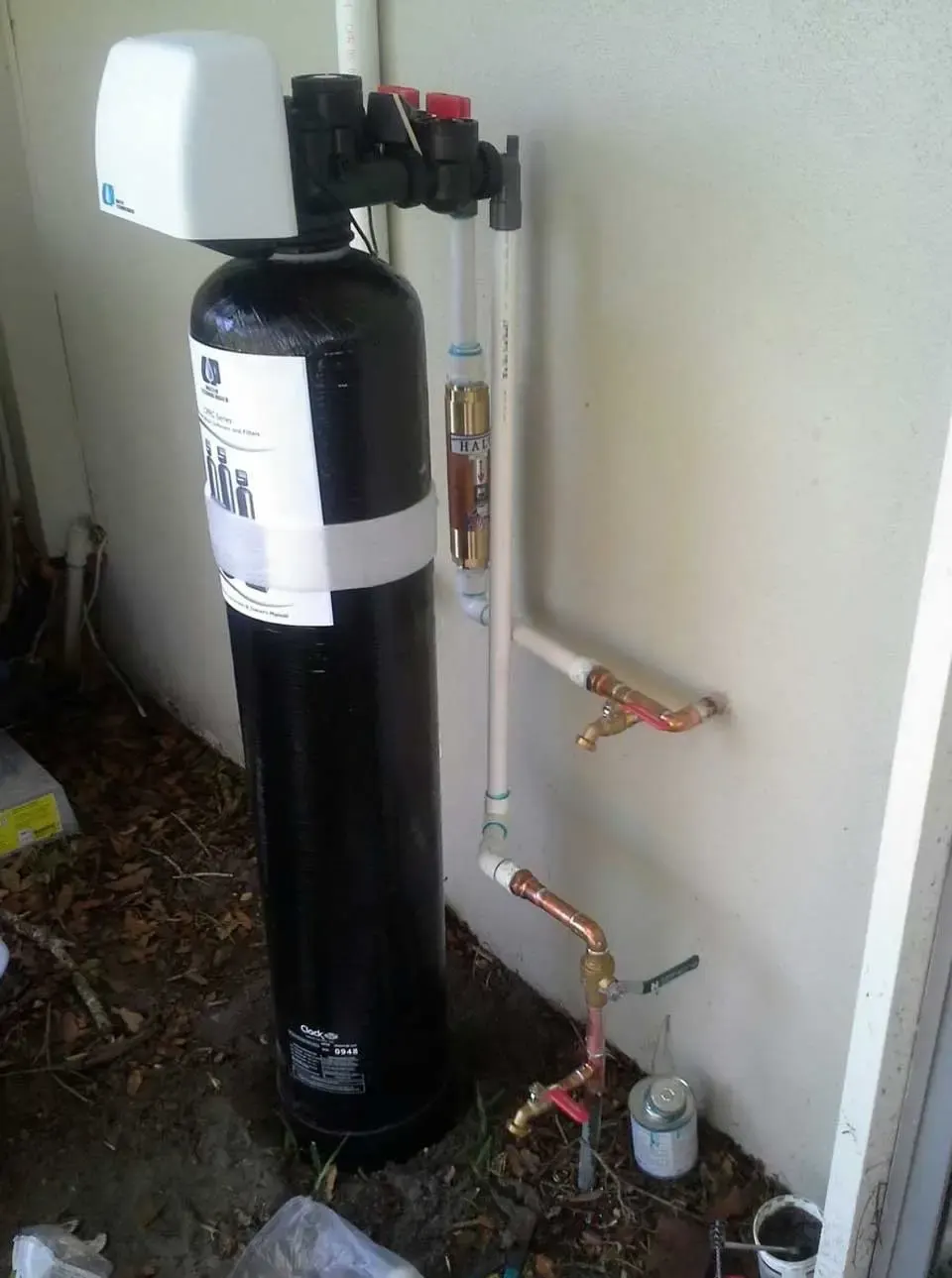
A whole house water filter, also called a point-of-entry system, is treatment equipment installed on the main water line where it enters your home. Because it sits upstream of everything else, the water reaching your kitchen faucet, your showers, your washing machine and your water heater has all passed through it. That's the key difference from a pitcher or under-sink filter, which only treats water at one spot. Below, we explain how these systems are put together, what each stage does and the practical questions to answer before installing one.
How a Point-of-Entry System Is Plumbed
Picture the path water takes into your house. On city water, it comes from the meter through a main line into the home. On a well, it comes from the pump into a pressure tank. A whole house system is spliced into that line before it branches off to individual fixtures.
A typical installation includes:
- A bypass valve, so water can flow around the equipment during maintenance or in an emergency.
- Shutoff valves on each side of the system.
- The treatment stages themselves, in a specific order.
- A drain connection for equipment that backwashes or regenerates, such as softeners and some carbon tanks.
- Power, if the equipment uses a control valve or UV lamp.
In many Florida homes, the garage is a natural spot because the main line often runs nearby and there's room for tanks. Our installers look at where the line enters, available drain and power, and how easy it will be for you to reach the equipment for routine upkeep.
The Stages, in Order
Whole-house systems are usually built in stages, and order matters because each stage protects the next one.
- Sediment prefilter. Catches particles first so they don't foul the stages after it.
- Activated carbon. A large tank or high-capacity cartridge for chlorine taste and odor; on city water, often the heart of the system.
- Softener, if needed. Removes the hardness minerals that cause scale, which carbon doesn't.
- Specialty or disinfection stages, if needed. Well systems may add stages for iron or sulfur odor, or UV, which needs clear, filtered water.
How each of these technologies works is covered in our primer on understanding water purification.
Not every home needs every stage. A good design starts with a water test, which homeowners can arrange through a certified lab; ask about testing when you schedule a consultation.
A Note on Reverse Osmosis
You'll sometimes see reverse osmosis described as a whole-house option. It's possible, but it's uncommon in homes. Whole-house RO requires substantial storage, a repressurization pump and a plan for the reject water it sends to the drain, and its output is usually more treatment than showers and toilets need. In most homes, RO is installed at the kitchen sink, while point-of-entry equipment handles sediment, chlorine and hardness for the whole house.
Whole House vs. Single-Tap Filters
| Whole house (point-of-entry) | Single tap (point-of-use) | |
|---|---|---|
| Water treated | Every fixture and appliance | One faucet |
| Main strengths | Chlorine taste and odor, sediment, hardness (with softener) | Drinking and cooking water quality |
| Typical location | Garage or utility area | Under the kitchen sink |
| Protects appliances and fixtures | Yes | No |
Many households end up with both.
Questions to Answer Before You Buy
- What's in your water? Hardness, sediment, chlorine taste, iron or odor each call for different stages.
- How much water do you use at once? The system must be sized for your home's peak flow so showers don't weaken when the dishwasher runs. Undersizing is an easy mistake with off-the-shelf equipment.
- Where will it go? You need floor or wall space, a drain for regenerating equipment and room to change filters.
- How much maintenance are you comfortable with? Cartridges get replaced, softener salt gets refilled and some tanks backwash automatically. Ask what the routine looks like before you choose.
What You'll Notice Afterward
With sediment and carbon stages, water at every tap typically tastes and smells cleaner. Add a softener and you'll see less new scale on faucets, glass and tile. That's especially welcome if you've recently invested in new bathroom sinks and faucets or a glass shower enclosure. For a fuller list of the day-to-day payoffs, read how water treatment benefits you, and if you're seeing crusty buildup now, check our rundown of the signs of hard water.
Today's Home Services designs and installs whole-house water purification systems for homes in Lakewood Ranch, Bradenton, Sarasota and the surrounding area. If you'd like us to look at your water and your space, just ask for a free estimate.
Frequently Asked Questions
Where is a whole house water filter installed?
Will a whole house filter lower my water pressure?
Do I still need a filter at the kitchen sink?
Is a whole house filter the same as a water softener?
Keep Exploring
-
Water Purification Systems
Scale on your shower glass, spots on your dishes and water that tastes of chlorine all have fixes. We help you understand what's in your water,…
-
 Blog
Understanding Water Purification
Filters, softeners, membranes and UV lamps all get called "water purification," but each one solves a different problem. Here's how they work, so you can match…
-
 Blog
How Water Treatment Benefits You
Treated water shows up in more places than your drinking glass. Walk through the house with us and see where filtration and softening make a practical…
-
Water Purification Systems in Lakewood Ranch, FL
A newer home doesn't mean softer water. We help Lakewood Ranch homeowners protect new fixtures, water heaters and shower glass with filtration and softening sized to…
-
 Bathroom Service
Bathroom Sinks and Faucets
The sink and faucet are what you touch every morning and every night. Getting the basin, the faucet drilling and the finish to work together is…